
Picture yourself standing before an empty street at dawn, camera pressed against your eye, searching for the invisible thread that will pull a viewer straight into the frame. That invisible thread is Leading lines, and every lens in your bag bends, magnifies, and translates those lines in a unique way. Understanding the optics behind the glass is the difference between a simple snapshot and a photograph that compels.
Why Lens Choice Shapes Your Lines
Wide-angle lenses exaggerate perspective, stretching sidewalks, rivers, or rails so they race toward the horizon. Telephoto glass, in contrast, compresses space—parallel pier planks seem to stack tightly, guiding the eye with subtle authority. Each focal length changes the speed at which Leading lines travel across a photo; a critical nuance when you’re crafting narrative with geometry.
Optics and Their Personalities
- Prime lenses bring edge-to-edge sharpness, perfect for architectural beams that must stay tack-sharp from corner to corner.
- Zoom lenses add flexibility; a slight twist can fine-tune the convergence of streetlight poles or alleyway bricks until they whisper exactly the story you want to tell.
- Tilt-shift lenses let you realign converging verticals, keeping skyscraper walls parallel while maintaining the pull of their vertical Leading lines.
Field Technique: Drawing the Viewer In
Once optics are chosen, position becomes choreography. Drop to knee level with a 24 mm lens and a boardwalk’s planks transform into racing stripes, propelling the viewer forward. Elevate the camera, swap to a 70–200 mm, and riverbanks funnel attention toward a distant boat, compressing story and subject into one heartbeat.
Light, Texture, and Contrast
Optical coatings matter when backlight hits glossy wet asphalt. A high-quality multi-coating preserves micro-contrast so the white reflector lines on the road stay crisp, acting as luminous guides. Low contrast from flare can weaken Leading lines, so use a lens hood or your hand to shield stray rays.
Practical Exercises
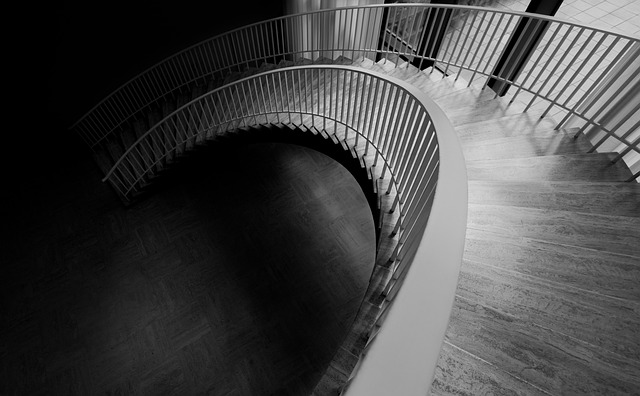
1. Mount your widest lens and find a staircase. Start at the base, then climb halfway and observe how the rails’ Leading lines pivot in relation to your sensor.
2. Switch to a telephoto at the same location. Note the compression; distant steps seem to stack like pages in a closed book.
3. Finally, revisit the scene at blue hour. Long exposures turn passing commuters into ghosts, while the stairs’ edges remain the anchor—proof that optics and time merge to emphasize guidance.
Every camera body records photons, but lenses sculpt them. When you deliberately marry focal length, aperture, and viewpoint, Leading lines become more than composition rule—they’re a visceral pulse the audience feels, an optical path straight to the photograph’s heart.